Want to save money and not freeze this winter? Here's how...
http://www.baltimoremagazine.net/2014/11/28/the-cheapskates-guide-to-home-heating
Showing posts with label energy. Show all posts
Friday, December 19, 2014
Saturday, October 4, 2014
Origami solar arrays in space
Origami? In space? That's right: NASA is partnering with engineers to design collapsible solar arrays to be deployed in space. Here's a polynomial optimization project for your high school math students using this theme.
Monday, August 27, 2012
Light bulbs to bring home
Looking for CFLs or LED bulbs that will cast the most aesthetically pleasing light? Here are two recommended by professional lighting designers:
Philips EnergySaver Twister Warm White 13W
http://www.goodhousekeeping.com/product-reviews/eco-friendly-products/light-bulb-reviews/philips-energysaver-13w-t2-twister-soft-white-light-bulb-59
Philips AmbientLED 25W A19
http://www.amazon.com/Philips-Ambient-5-watt-Light-Bulb/dp/B005POXQSO
Remember that although LED bulbs are more expensive, they also last significantly longer; therefore they are more economical over the long run.
Philips EnergySaver Twister Warm White 13W
http://www.goodhousekeeping.com/product-reviews/eco-friendly-products/light-bulb-reviews/philips-energysaver-13w-t2-twister-soft-white-light-bulb-59
Philips AmbientLED 25W A19
http://www.amazon.com/Philips-Ambient-5-watt-Light-Bulb/dp/B005POXQSO
Remember that although LED bulbs are more expensive, they also last significantly longer; therefore they are more economical over the long run.
Friday, August 17, 2012
Why US gas prices are climbing again
Refinery issues disrupt supply:
http://www.environmentalleader.com/2012/08/13/fuel-prices-spike-following-chevron-fire/
US drought affects ethanol production:
http://www.theworld.org/2012/08/in-face-of-drought-un-asks-us-to-suspend-biofuel-mandate/
http://www.environmentalleader.com/2012/08/13/fuel-prices-spike-following-chevron-fire/
US drought affects ethanol production:
http://www.theworld.org/2012/08/in-face-of-drought-un-asks-us-to-suspend-biofuel-mandate/
Thursday, March 29, 2012
Energy metabolism: The Very Hungry City
Today's interview with author Austin Troy about his book The Very Hungry City... on WYPR today:
"How will Baltimore fare in the future as the global demand for energy grows and prices rise? Austin Troy, an expert in urban environmental management at the University of Vermont, looks at cities with "high energy metabolisms" and what they need to do about the problems of energy consumption. Troy is the author of The Very Hungry City: Will Your City Thrive or Wither in and Energy-Strapped Future?"
http://www.wypr.org/podcast/thursday-march-29-1-2-pm-very-hungry-city
This author mentioned a strong statistical correlation between trees and crime: the numbers show that neighborhoods with more trees experience lower crime rates. So... go plant trees!
Also: people who live in places with extensive bicycle infrastructure are happier about where they live. Copenhagen and the Nordic countries were mentioned in this context.
"How will Baltimore fare in the future as the global demand for energy grows and prices rise? Austin Troy, an expert in urban environmental management at the University of Vermont, looks at cities with "high energy metabolisms" and what they need to do about the problems of energy consumption. Troy is the author of The Very Hungry City: Will Your City Thrive or Wither in and Energy-Strapped Future?"
http://www.wypr.org/podcast/thursday-march-29-1-2-pm-very-hungry-city
This author mentioned a strong statistical correlation between trees and crime: the numbers show that neighborhoods with more trees experience lower crime rates. So... go plant trees!
Also: people who live in places with extensive bicycle infrastructure are happier about where they live. Copenhagen and the Nordic countries were mentioned in this context.
Sunday, December 4, 2011
Baby it's cold outside!
This Lifehacker article has winter preparation tips on everything from insulating windows, repurposing old sweaters as mittens, and fighting Seasonal Affective Disorder. Enjoy!
http://lifehacker.com/5864667/prepare-yourself-for-the-winter-cold-this-weekend
Wednesday, October 26, 2011
Shedding light on the subject of bulbs
What's the latest in light bulb news? Are CFLs safe? Do LEDs live up to the hype? Read the 2011 Consumer Reports guide to light bulbs and find out...
Here's a brief summary:
CFLs use about 75% less energy and last seven to ten times longer than regular incandescent bulbs. Consumer Reports tested 60-watt CFLs and LEDs for this report.
CFLs save money faster (one year) than LEDs (four to ten years). They also contain less mercury (<1mg), although CR notes that they should be recycled at stores like Home Depot, Ikea, Lowe’s, Ace Hardware, or other participating programs... but you were already recycling your light bulbs, right?
LEDs meet most of their claims (brightness, low energy use, no mercury, dimming capability, long lifespan) but can be suboptimal in light distribution, not all are as bright as promised, and they are still more expensive than CFLs.
What you should look for when shopping for light bulbs:
Lumens measure brightness better than wattage does. This article suggests a lumens equivalent for several common bulb types.
Brightness and color are not created equal.
Read the Lighting Facts label to check brightness, energy use, estimated energy cost, expected lifespan.
Check for rebates and coupons at www.dsireusa.org/incentives or http://www.energystar.gov/ or your local utility company.
Want more?
Read the full article and check bulb ratings here:
http://www.consumerreports.org/cro/resources/streaming/PDFs/Consumer+Reports+Lightbulb+Review+Facebook.pdf
Visit the Consumer Reports page on Facebook to get access to free reports like this without becoming a subscriber.
CR Facebook: https://www.facebook.com/ConsumerReports
CR main website: http://www.consumerreports.org/cro/index.htm
Here's a brief summary:
CFLs use about 75% less energy and last seven to ten times longer than regular incandescent bulbs. Consumer Reports tested 60-watt CFLs and LEDs for this report.
CFLs save money faster (one year) than LEDs (four to ten years). They also contain less mercury (<1mg), although CR notes that they should be recycled at stores like Home Depot, Ikea, Lowe’s, Ace Hardware, or other participating programs... but you were already recycling your light bulbs, right?
LEDs meet most of their claims (brightness, low energy use, no mercury, dimming capability, long lifespan) but can be suboptimal in light distribution, not all are as bright as promised, and they are still more expensive than CFLs.
What you should look for when shopping for light bulbs:
Lumens measure brightness better than wattage does. This article suggests a lumens equivalent for several common bulb types.
Brightness and color are not created equal.
Read the Lighting Facts label to check brightness, energy use, estimated energy cost, expected lifespan.
Check for rebates and coupons at www.dsireusa.org/incentives or http://www.energystar.gov/ or your local utility company.
Want more?
Read the full article and check bulb ratings here:
http://www.consumerreports.org/cro/resources/streaming/PDFs/Consumer+Reports+Lightbulb+Review+Facebook.pdf
Visit the Consumer Reports page on Facebook to get access to free reports like this without becoming a subscriber.
CR Facebook: https://www.facebook.com/ConsumerReports
CR main website: http://www.consumerreports.org/cro/index.htm
Tuesday, October 25, 2011
ACEEE state energy efficiency scorecards released
ACEEE Press release: MASSACHUSETTS OVERTAKES CALIFORNIA AS #1 ENERGY EFFICIENCY STATE, MICHIGAN AND ILLINOIS AMONG THE MOST IMPROVED
WASHINGTON, D.C. (October 20, 2011): A sour U.S. economy, tight state budgets, and a failure by Congress to adopt a comprehensive energy strategy have not slowed the growing momentum among U.S. states toward increased energy efficiency, according to the fifth edition of the annual ACEEE State Energy Efficiency Scorecard released today by the American Council for an Energy-Efficient Economy (ACEEE) during a National Press Club news conference.
Available online at http://aceee.org/research-report/e115 , the ACEEE Scorecard shows that the top 10 states are: Massachusetts (taking the #1 position for the first time); California (slipping from the top spot it held for the first four editions of the ACEEE Scorecard); New York State; Oregon; Vermont; Washington State; Rhode Island; Minnesota, Connecticut; and Maryland (making its first appearance in the top 10 and also one of the six most improved states in the 2011 ACEEE Scorecard).
The 10 states most in need of improvement (from dead last to #42) are: North Dakota; Wyoming; Mississippi; Kansas; Oklahoma; South Carolina; West Virginia; Missouri; Alabama (also one of the top six most improved states); and South Dakota.
The six most improved states include Michigan, Illinois, Nebraska, Alabama, Maryland, and Tennessee.
"Energy efficiency is America's abundant, untapped energy resource and the states continue to press forward to reap its economic and environmental benefits," said ACEEE Executive Director Steven Nadel. "The message here is that energy efficiency is a pragmatic, bipartisan solution that political leaders from both sides of the aisle can support. As they have over the past decades, states continue to provide the leadership needed to forge an energy-efficient economy, which reduces energy costs, spurs job growth, and benefits the environment."
"Thanks to our investments in innovation and infrastructure, Massachusetts is now leading the nation in energy efficiency," said Massachusetts Governor Deval Patrick. "Through our Green Communities Act, we set aggressive goals and laid the foundation for greater investment in energy efficiency -- and now we are proud to be a model for the nation and world."
"I am thrilled that Maryland is being recognized as one of the top ten states and one of the most improved states for energy efficiency," said Malcolm Woolf, director of the Maryland Energy Administration. "As a result of Governor O'Malley's vision in establishing one of the nation's most aggressive energy efficiency goals, Marylanders have already saved over 700,000 MWh of electricity and over $91 million dollars since 2009, and our peak demand program has helped us avoid major blackouts during our record-setting summer heat wave."
"Illinois is a purposeful leader in the area of sustainability, investing more than $600 million in energy efficiency projects over the last four years alone," Illinois Department of Commerce and Economic Opportunity Director Warren Ribley said. "By supporting aggressive policies including the state's energy efficiency portfolio standard and advanced building industry training and education, we are creating jobs, building more sustainable communities and securing our place in the new energy economy."
"We are excited that Michigan's positive action on energy efficiency is being recognized nationally," said Valerie Brader, the chief energy policy officer for the Michigan Economic Development Corporation. The ACEEE report observed that Michigan's improvement is particularly due to the implementation of energy efficiency programs advanced in state legislation P.A. 295.
The fifth edition of the ACEEE State Energy Efficiency Scorecard presents a comprehensive ranking of the states based on an array of metrics that capture best practices and recognize leadership in energy efficiency policy and program implementation. The Scorecard benchmarks progress and provides a roadmap for states to advance energy efficiency in the residential, commercial, industrial, and transportation sectors. A new, diverse set of states has followed a group of leading states by adopting significant energy efficiency policies, which will lead to innovative and effective programs. Tremendous potential remains for energy efficiency savings in all of the states should motivate decision-makers to advance energy efficiency.
"Clearly, 2011 has not been kind to our economy, but energy efficiency remains a growth sector that attracts investment and creates jobs," said Michael Sciortino, ACEEE senior policy analyst and the report's lead author. "With even higher energy savings possible, we expect leading states to continue pushing the envelope next year and inspire those at the bottom of the rankings to embrace energy efficiency as a core strategy to gain a competitive advantage by generating cost-savings, promoting technological innovation, and stimulating growth."
OTHER KEY FINDINGS
Facing uncertain economic times, states are continuing to use energy efficiency as a key strategy to generate cost-savings, promote technological innovation, and stimulate growth. The ACEEE Scorecard documents the following trends:
• Total budgets for electricity efficiency programs increased to $4.5 billion in 2010, up from $3.4 billion in 2009. Combined with natural gas program budgets of about $1 billion, total energy efficiency budgets in 2010 equal about $5.5 billion. Given the increasing regulatory commitments to energy efficiency, this growth will likely continue over the next decade.
• Twenty-nine (29) states have either adopted or have made significant progress toward the adoption of the latest energy-saving building codes for homes and commercial properties - up from twenty in 2010 and ten in 2009.
• Twenty-four (24) states have adopted an Energy Efficiency Resource Standard (EERS), which sets long-term energy savings targets and drives utility-sector investments in energy efficiency programs. States that adopted EERS policies in 2007 and 2008 are now realizing significant energy savings and moving ahead in the Scorecard rankings.
• States continue to improve policies to reduce financial, technical, and regulatory barriers to adoption and deployment of combined heat and power (CHP) systems, which generate electricity and thermal energy in an integrated system. Tremendous potential remains for CHP, particularly in states with heavy industrial and manufacturing bases.
• A group of leading states remains ahead of the curve in adopting policies to reduce vehicle miles traveled and promote the purchase and manufacture of efficient vehicles. A major gap exists, however, as over half the states have minimal or no policies to encourage efficiency in the transportation sector.
Methodology
This ACEEE Scorecard provides a comprehensive assessment of policy and programs that improve energy efficiency in our homes, businesses, industry, and transportation sectors. The Scorecard examines six state energy efficiency policy areas and presents these results in six chapters: (1) utility and public benefits programs and policies; (2) transportation policies; (3) building energy codes; (4) combined heat and power; (5) state government initiatives; and (6) appliance efficiency standards. States can earn up to 50 possible points in these six policy areas combined, with the maximum possible points in each area weighted by the magnitude of its potential energy savings impact.
ABOUT ACEEE
The American Council for an Energy-Efficient Economy acts as a catalyst to advance energy efficiency policies, programs, technologies, investments, and behaviors. For information about ACEEE and its programs, publications, and conferences, visit http://www.aceee.org/
MEDIA CONTACT: Patrick Mitchell at (703) 276-3266 or pmitchell@hastingsgroup.com
EDITOR'S NOTE: A streaming audio replay of the news event will be available at http://www.hastingsgroupmedia.com/aceee/102011ScorecardReport.mp3 , an electronic copy of the ACEEE 2011 State Energy Efficiency Scorecard report and a high-resolution image of the ACEEE "logo" will be made available upon request on October 20, 2011.
WASHINGTON, D.C. (October 20, 2011): A sour U.S. economy, tight state budgets, and a failure by Congress to adopt a comprehensive energy strategy have not slowed the growing momentum among U.S. states toward increased energy efficiency, according to the fifth edition of the annual ACEEE State Energy Efficiency Scorecard released today by the American Council for an Energy-Efficient Economy (ACEEE) during a National Press Club news conference.
Available online at http://aceee.org/research-report/e115 , the ACEEE Scorecard shows that the top 10 states are: Massachusetts (taking the #1 position for the first time); California (slipping from the top spot it held for the first four editions of the ACEEE Scorecard); New York State; Oregon; Vermont; Washington State; Rhode Island; Minnesota, Connecticut; and Maryland (making its first appearance in the top 10 and also one of the six most improved states in the 2011 ACEEE Scorecard).
The 10 states most in need of improvement (from dead last to #42) are: North Dakota; Wyoming; Mississippi; Kansas; Oklahoma; South Carolina; West Virginia; Missouri; Alabama (also one of the top six most improved states); and South Dakota.
The six most improved states include Michigan, Illinois, Nebraska, Alabama, Maryland, and Tennessee.
"Energy efficiency is America's abundant, untapped energy resource and the states continue to press forward to reap its economic and environmental benefits," said ACEEE Executive Director Steven Nadel. "The message here is that energy efficiency is a pragmatic, bipartisan solution that political leaders from both sides of the aisle can support. As they have over the past decades, states continue to provide the leadership needed to forge an energy-efficient economy, which reduces energy costs, spurs job growth, and benefits the environment."
"Thanks to our investments in innovation and infrastructure, Massachusetts is now leading the nation in energy efficiency," said Massachusetts Governor Deval Patrick. "Through our Green Communities Act, we set aggressive goals and laid the foundation for greater investment in energy efficiency -- and now we are proud to be a model for the nation and world."
"I am thrilled that Maryland is being recognized as one of the top ten states and one of the most improved states for energy efficiency," said Malcolm Woolf, director of the Maryland Energy Administration. "As a result of Governor O'Malley's vision in establishing one of the nation's most aggressive energy efficiency goals, Marylanders have already saved over 700,000 MWh of electricity and over $91 million dollars since 2009, and our peak demand program has helped us avoid major blackouts during our record-setting summer heat wave."
"Illinois is a purposeful leader in the area of sustainability, investing more than $600 million in energy efficiency projects over the last four years alone," Illinois Department of Commerce and Economic Opportunity Director Warren Ribley said. "By supporting aggressive policies including the state's energy efficiency portfolio standard and advanced building industry training and education, we are creating jobs, building more sustainable communities and securing our place in the new energy economy."
"We are excited that Michigan's positive action on energy efficiency is being recognized nationally," said Valerie Brader, the chief energy policy officer for the Michigan Economic Development Corporation. The ACEEE report observed that Michigan's improvement is particularly due to the implementation of energy efficiency programs advanced in state legislation P.A. 295.
The fifth edition of the ACEEE State Energy Efficiency Scorecard presents a comprehensive ranking of the states based on an array of metrics that capture best practices and recognize leadership in energy efficiency policy and program implementation. The Scorecard benchmarks progress and provides a roadmap for states to advance energy efficiency in the residential, commercial, industrial, and transportation sectors. A new, diverse set of states has followed a group of leading states by adopting significant energy efficiency policies, which will lead to innovative and effective programs. Tremendous potential remains for energy efficiency savings in all of the states should motivate decision-makers to advance energy efficiency.
"Clearly, 2011 has not been kind to our economy, but energy efficiency remains a growth sector that attracts investment and creates jobs," said Michael Sciortino, ACEEE senior policy analyst and the report's lead author. "With even higher energy savings possible, we expect leading states to continue pushing the envelope next year and inspire those at the bottom of the rankings to embrace energy efficiency as a core strategy to gain a competitive advantage by generating cost-savings, promoting technological innovation, and stimulating growth."
OTHER KEY FINDINGS
Facing uncertain economic times, states are continuing to use energy efficiency as a key strategy to generate cost-savings, promote technological innovation, and stimulate growth. The ACEEE Scorecard documents the following trends:
• Total budgets for electricity efficiency programs increased to $4.5 billion in 2010, up from $3.4 billion in 2009. Combined with natural gas program budgets of about $1 billion, total energy efficiency budgets in 2010 equal about $5.5 billion. Given the increasing regulatory commitments to energy efficiency, this growth will likely continue over the next decade.
• Twenty-nine (29) states have either adopted or have made significant progress toward the adoption of the latest energy-saving building codes for homes and commercial properties - up from twenty in 2010 and ten in 2009.
• Twenty-four (24) states have adopted an Energy Efficiency Resource Standard (EERS), which sets long-term energy savings targets and drives utility-sector investments in energy efficiency programs. States that adopted EERS policies in 2007 and 2008 are now realizing significant energy savings and moving ahead in the Scorecard rankings.
• States continue to improve policies to reduce financial, technical, and regulatory barriers to adoption and deployment of combined heat and power (CHP) systems, which generate electricity and thermal energy in an integrated system. Tremendous potential remains for CHP, particularly in states with heavy industrial and manufacturing bases.
• A group of leading states remains ahead of the curve in adopting policies to reduce vehicle miles traveled and promote the purchase and manufacture of efficient vehicles. A major gap exists, however, as over half the states have minimal or no policies to encourage efficiency in the transportation sector.
Methodology
This ACEEE Scorecard provides a comprehensive assessment of policy and programs that improve energy efficiency in our homes, businesses, industry, and transportation sectors. The Scorecard examines six state energy efficiency policy areas and presents these results in six chapters: (1) utility and public benefits programs and policies; (2) transportation policies; (3) building energy codes; (4) combined heat and power; (5) state government initiatives; and (6) appliance efficiency standards. States can earn up to 50 possible points in these six policy areas combined, with the maximum possible points in each area weighted by the magnitude of its potential energy savings impact.
ABOUT ACEEE
The American Council for an Energy-Efficient Economy acts as a catalyst to advance energy efficiency policies, programs, technologies, investments, and behaviors. For information about ACEEE and its programs, publications, and conferences, visit http://www.aceee.org/
MEDIA CONTACT: Patrick Mitchell at (703) 276-3266 or pmitchell@hastingsgroup.com
EDITOR'S NOTE: A streaming audio replay of the news event will be available at http://www.hastingsgroupmedia.com/aceee/102011ScorecardReport.mp3 , an electronic copy of the ACEEE 2011 State Energy Efficiency Scorecard report and a high-resolution image of the ACEEE "logo" will be made available upon request on October 20, 2011.
Wednesday, August 31, 2011
Countdown to the 2011 Solar Decathlon
Are you ready for the Solar Decathlon in Washington DC next month? The EERE sure is: they've been profiling a different entry in their e-newsletter each week as they count down to the event. For instance...
Students from the University of Tennessee at Knoxville use an iPad to monitor their house's energy systems.
Florida International University's perFORM[D]ance House focuses on sustainability.
University of Maryland's WaterShed entry aims to bring attention to the Chesapeake Bay, which is the largest estuary in the USA.
The next Solar Decathlon will be held Sept. 23–Oct. 2, 2011, at the National Mall’s West Potomac Park in Washington, D.C. Go check it out!
For more information, visit SolarDecathlon.gov
Join the clean energy conversation on Facebook at DOE's Energy Efficiency and Renewable Energy, Energy Savers, and Solar Decathlon pages.
Read about the last Solar Decathlon in 2009 here.
Friday, July 8, 2011
Don't repeal the bulb act!
Next week, the House of Representatives is expected to vote on the "BULB Act" (H.R. 91), which would repeal the energy efficiency standards for light bulbs that Congress enacted in 2007, standards that are already helping American households save money every month on their energy bills. Let your Representative know that you oppose the repeal of this energy- and money-saving legislation.
Tell your Representative to oppose the BULB Act or other bills that repeal light bulb energy efficiency standards!
More Options, Better Bulbs, Less Energy Used
Proponents of the BULB Act claim the standards they want to repeal amount to a light bulb "ban" that limits consumers' choices. That couldn't be further from the truth.
The Facts:
• Incandescent bulbs aren't getting banned... in fact, they are getting better. Manufacturers are already making a variety of new energy-saving bulbs for homes, including more efficient incandescent bulbs.
• The new incandescent bulbs look, light, and turn on exactly like the bulbs we have been using for decades, but are 28 to 33 percent more energy efficient and are available in stores now.
• Consumers aren't required to "retire" bulbs or to purchase only CFL or LED light bulbs ---- consumers can use existing bulbs until they burn out and when a bulb burns out consumers can choose between efficient incandescent lamps or even more efficient CFL or LED light bulb options.
• The lighting industry supports this standard, along with efficiency, consumer, and environmental advocates.
Energy-efficient lighting saves consumers money, creates jobs, and benefits the environment. At a time when families are struggling with high energy costs, efficient lighting will save the average American family $50-100 every year on the electric bill (about $12 billion nationwide), and save enough energy annually to power all the homes in Pennsylvania and Tennessee.
Phasing-in energy-efficient light bulbs means more choices and more ways to save on energy. We urge you to write your Representative and let him/her know you strongly oppose repeal of the light bulb efficiency standards.
Tell your Representative to oppose the BULB Act and similar bills!
Thank you for your support!
Sincerely,
ACEEE
http://www.aceee.org/
Tell your Representative to oppose the BULB Act or other bills that repeal light bulb energy efficiency standards!
More Options, Better Bulbs, Less Energy Used
Proponents of the BULB Act claim the standards they want to repeal amount to a light bulb "ban" that limits consumers' choices. That couldn't be further from the truth.
The Facts:
• Incandescent bulbs aren't getting banned... in fact, they are getting better. Manufacturers are already making a variety of new energy-saving bulbs for homes, including more efficient incandescent bulbs.
• The new incandescent bulbs look, light, and turn on exactly like the bulbs we have been using for decades, but are 28 to 33 percent more energy efficient and are available in stores now.
• Consumers aren't required to "retire" bulbs or to purchase only CFL or LED light bulbs ---- consumers can use existing bulbs until they burn out and when a bulb burns out consumers can choose between efficient incandescent lamps or even more efficient CFL or LED light bulb options.
• The lighting industry supports this standard, along with efficiency, consumer, and environmental advocates.
Energy-efficient lighting saves consumers money, creates jobs, and benefits the environment. At a time when families are struggling with high energy costs, efficient lighting will save the average American family $50-100 every year on the electric bill (about $12 billion nationwide), and save enough energy annually to power all the homes in Pennsylvania and Tennessee.
Phasing-in energy-efficient light bulbs means more choices and more ways to save on energy. We urge you to write your Representative and let him/her know you strongly oppose repeal of the light bulb efficiency standards.
Tell your Representative to oppose the BULB Act and similar bills!
Thank you for your support!
Sincerely,
ACEEE
http://www.aceee.org/
Tuesday, April 19, 2011
What makes a computer Energy Star material?
Ever wonder why some computer equipment qualifies for Energy Star rating and others don't? Me too. Here are some facts from the Energy Star website.
Product criteria must show that the equipment can:
- Use energy efficient power supply.
- Operate efficiently in multiple modes of operation (Off, Sleep, and Idle).
- Include and enable power management features of the system and provide user education about these features.
You Should Know...
Monitors: Switching on and off the monitor five times or more a day increases the frequency of faults in power transistors in the control and deflection parts only after the machine has been used 20 to 30 years.
Saturday, March 12, 2011
Wednesday, February 23, 2011
Time to shine: new location for 2011 Solar Decathlon in September
Energy, Interior Departments Announce New Location for Solar Decathlon 2011
http://apps1.eere.energy.gov/news/progress_alerts.cfm/pa_id=489
February 23, 2011
The Department of Energy and the Department of the Interior today announced that the U.S. Department of Energy Solar Decathlon 2011 will be held at the National Mall's West Potomac Park, on the banks of the Potomac River along the path between the Lincoln and Jefferson Memorials. Specifically, the event will be held on the peninsula just south of the new Martin Luther King Jr. National Memorial—scheduled to open in August of this year—between the Franklin Delano Roosevelt Memorial and the Potomac River. The Decathlon will begin in late September as originally scheduled.
The event is being moved from its previous location on the Mall between the Washington Monument and the Capitol to balance the many uses and demands on the Mall.
"We look forward to holding another world-class Solar Decathlon in a world-class location—the National Mall's West Potomac Park," said Secretary Chu. "Keeping the competition on the National Mall property allows the students to proceed with their existing home designs, specifically tailored for Washington's latitude, temperature, and humidity conditions. The West Potomac site is in close proximity to a number of attractions and will provide an ideal stage to highlight clean energy solutions for thousands of public visitors."
"Solar energy is a key component of President Obama's vision for a new energy future and the solar decathlon is part of that future," said Secretary Salazar. "The National Mall is America's front yard and we have a responsibility to do what is best for the long term health of the Mall. I am pleased that we have been able to find a strong alternate location for the Solar Decathlon and I am looking forward to a successful event."
The U.S. Department of Energy Solar Decathlon is a competition that challenges collegiate students from across the globe to design, build, and operate solar-powered houses that are affordable, highly energy-efficient, attractive, and easy to live in. During the competition, 20 homes from 16 domestic and four international collegiate teams will undergo extensive testing and expert judging in ten different contest categories. The winner of the competition is the team that best blends affordability, consumer appeal, and design excellence with optimal energy production and maximum efficiency. This will be DOE's fifth Solar Decathlon; previous events were held in 2002, 2005, 2007, and 2009.
The Solar Decathlon provides participating students with unique training to enter our nation's clean-energy workforce. It is also a popular public event, open to visitors who come to see the designs and learn about money-saving clean-energy solutions for their own homes. The public will be encouraged to meet the students and visit their highly efficient, innovative solar homes during the event. Specific public viewing hours for this year's competition will be published at a later date.
See a preliminary layout of the National Mall's West Potomac Park site here: http://www.solardecathlon.gov/pdfs/2011_map.pdf
The Solar Decathlon supports the Obama Administration's goal of creating an economy based on clean-energy technologies while saving families and businesses money and reducing reliance on fossil fuels.
For more information, please visit SolarDecathlon.gov
Monday, November 8, 2010
TV news: watch your energy
FTC Will Require EnergyGuide Labels for Televisions
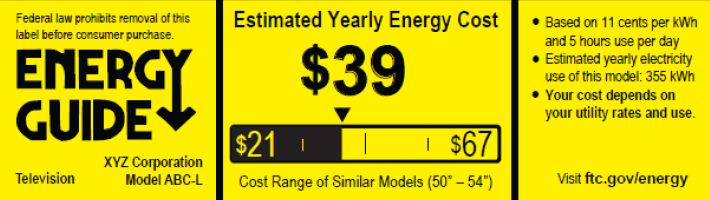
Televisions manufactured after May 10, 2011 must display EnergyGuide labels, the Federal Trade Commission (FTC) said on October 27. A recent amendment to the FTC's Appliance Labeling Rule will require the familiar yellow-and-black labels on new TVs. The removable labels, which have long been used on home appliances such as washing machines and refrigerators, are designed to provide energy cost information.
In March 2009, the FTC sought comments on whether EnergyGuide labels should be required on a range of consumer electronics, including televisions. Based on the response, in March 2010, the agency proposed requiring the labels on televisions sold in the United States. The FTC is requiring a label with two main disclosures on new TVs: the television set's estimated annual energy cost and a comparison with the annual energy cost of other televisions with similar screen sizes. The new rule requires that the new labels be visible from the front of the televisions. Beginning in July 11, 2011, the amended rule will require Web sites that sell televisions to display an image of the full EnergyGuide label. See the FTC press release, the Federal Register Final Rule notice, and examples of the FTC labels.
Also, the FTC is proposing revisions to the guidance it gives marketers to help them avoid misleading environmental claims about their products. The agency announced on October 6 that it is seeking public comments about changes to the Green Guides on such topics as renewable energy and carbon offset claims. The FTC, in its proposed revisions, notes that general "eco-friendly" claims are difficult, if not impossible, to substantiate. The agency will accept public input until December 10, 2010, after which it will decide what final changes it will make to the guidelines. See the FTC press release, which includes an electronic link for comment submissions, the summary of proposed Green Guides changes, and the full list of proposed changes.
More info at http://www.ftc.gov/energy/
Wednesday, September 29, 2010
ASES National Solar Tour
Just because 2010 is an off-year for the biennial Solar Decathlon doesn't mean you can't get your solar fix. The nonprofit American Solar Energy Society (ASES) is coordinating a grassroots tour of homes and buildings across the country: check out their website to find a tour near you. Most tours are taking place on the first Saturday in October, but other events will spill over into the rest of National Energy Awareness month.
I braved the rain and mud at the Solar Decathlon on the mall in DC last year, and glad I did! The 2011 Solar Decathlon will be held Sept 23 - Oct 2, here's the website: http://www.solardecathlon.gov/ and the EERE announcement from the Department of Energy.
Monday, September 27, 2010
Go Mountaineers!
EPA Welcomes West Virginia University as Newest Partner in Regional Sustainability Initiative
MORGANTOWN, W. Va. - - September 21, 2010 Today, West Virginia University became the latest organization to join the U.S. Environmental Protection Agency’s Sustainability Partnership Program (SPP) in a signing ceremony held at the University President’s Office. EPA Regional Administrator Shawn M. Garvin joined Cabinet Secretary Randy Huffman of the West Virginia Department of Environmental Protection (WVDEP) in recognizing West Virginia University (WVU).
University President James P. Clements signed the agreement on behalf of the school, formalizing the new working partnership.
“WVU has already taken many progressive steps to reduce the overall environmental footprint of the campus, and EPA is pleased to support and further those efforts” said EPA mid-Atlantic Regional Administrator, Shawn M. Garvin. “Through our partnership we expect that both sides will benefit as we build on current successes and then share those practices with other colleges and organizations.”
The Sustainability Partnership is an innovative program developed by EPA’s mid-Atlantic region to create a one-stop shopping approach for organizations that use large quantities of energy, water, and natural resources and want to go green. Instead of dealing with each of EPA's voluntary programs individually, EPA staff will work out a comprehensive ‘green’ plan for organizations that often saves money and makes good business sense. The overall goal of the SPP is to minimize the use of energy, resources and waste generation in the mid-Atlantic states.
The centerpiece of West Virginia University's sustainability effort is a performance contract to make existing buildings energy efficient. By 2016, the university expects to spend $50 million on updating equipment and installing energy saving upgrades in all of its campuses, including WVU Tech, Potomac State College and WVU-Parkersburg. So far the Evansdale campus has been completed, and the university has already spent about $20 million.
Following this project, the university is expected to reach a carbon dioxide emission level that is 31.5 percent less than a typical educational complex its size.
"We are pleased to partner with the EPA as part of our commitment to a sustainable campus," said WVU President James P. Clements. "We have integrated sustainability practices throughout the University - from buildings to our transportation systems, to the cleaning products we use. I would like to thank Clement Solomon, WVU's director of sustainability, and all those throughout the University who demonstrate this commitment daily."
The West Virginia Department of Environmental Protection has entered into an agreement with EPA and is helping to promote the SPP throughout the state.
“It is a great day for West Virginia University with the signing of the Sustainability Partnership Agreement,” said WVDEP Cabinet Secretary Randy Huffman. “West Virginia University’s commitment to developing sustainable energy, water, and waste conservation practices in harmony with preserving West Virginia’s economy, environment, and communities for future generations speaks volumes of the many contributions already made to create a sustainable school. By signing this agreement, West Virginia University is well on their way to preparing our young people for generations of sustainable living, through its education, its fabric, and its daily practices.”
For information on the Sustainability Partnership go to: http://www.epa.gov/reg3wcmd/spp/index.html or call, 215-814-3110.
More links:
Individual Sustainability Partnership Programs Mid-Atlantic Sustainability Partnership US EPA
http://www.wvu.edu/
MORGANTOWN, W. Va. - - September 21, 2010 Today, West Virginia University became the latest organization to join the U.S. Environmental Protection Agency’s Sustainability Partnership Program (SPP) in a signing ceremony held at the University President’s Office. EPA Regional Administrator Shawn M. Garvin joined Cabinet Secretary Randy Huffman of the West Virginia Department of Environmental Protection (WVDEP) in recognizing West Virginia University (WVU).
University President James P. Clements signed the agreement on behalf of the school, formalizing the new working partnership.
“WVU has already taken many progressive steps to reduce the overall environmental footprint of the campus, and EPA is pleased to support and further those efforts” said EPA mid-Atlantic Regional Administrator, Shawn M. Garvin. “Through our partnership we expect that both sides will benefit as we build on current successes and then share those practices with other colleges and organizations.”
The Sustainability Partnership is an innovative program developed by EPA’s mid-Atlantic region to create a one-stop shopping approach for organizations that use large quantities of energy, water, and natural resources and want to go green. Instead of dealing with each of EPA's voluntary programs individually, EPA staff will work out a comprehensive ‘green’ plan for organizations that often saves money and makes good business sense. The overall goal of the SPP is to minimize the use of energy, resources and waste generation in the mid-Atlantic states.
The centerpiece of West Virginia University's sustainability effort is a performance contract to make existing buildings energy efficient. By 2016, the university expects to spend $50 million on updating equipment and installing energy saving upgrades in all of its campuses, including WVU Tech, Potomac State College and WVU-Parkersburg. So far the Evansdale campus has been completed, and the university has already spent about $20 million.
Following this project, the university is expected to reach a carbon dioxide emission level that is 31.5 percent less than a typical educational complex its size.
"We are pleased to partner with the EPA as part of our commitment to a sustainable campus," said WVU President James P. Clements. "We have integrated sustainability practices throughout the University - from buildings to our transportation systems, to the cleaning products we use. I would like to thank Clement Solomon, WVU's director of sustainability, and all those throughout the University who demonstrate this commitment daily."
The West Virginia Department of Environmental Protection has entered into an agreement with EPA and is helping to promote the SPP throughout the state.
“It is a great day for West Virginia University with the signing of the Sustainability Partnership Agreement,” said WVDEP Cabinet Secretary Randy Huffman. “West Virginia University’s commitment to developing sustainable energy, water, and waste conservation practices in harmony with preserving West Virginia’s economy, environment, and communities for future generations speaks volumes of the many contributions already made to create a sustainable school. By signing this agreement, West Virginia University is well on their way to preparing our young people for generations of sustainable living, through its education, its fabric, and its daily practices.”
For information on the Sustainability Partnership go to: http://www.epa.gov/reg3wcmd/spp/index.html or call, 215-814-3110.
More links:
Individual Sustainability Partnership Programs Mid-Atlantic Sustainability Partnership US EPA
http://www.wvu.edu/
Saturday, September 4, 2010
Weatherize now!
Here's a link to a comparison-shopping guide for weatherstripping on the DOE website:
http://www.energysavers.gov/your_home/insulation_airsealing/index.cfm/mytopic=11280
Also, now is the best time to get your furnace serviced, chimney swept, and all that jazz before heating season is upon us.
Thursday, August 26, 2010
Green home-building and gadgetry
Here's a green home news roundup from NYTimes...
...a LEED platinum home near Lake Michigan http://www.nytimes.com/2010/08/26/garden/26racine.html?pagewanted=1&tntemail1=y&emc=tnt
...more about its green features http://www.nytimes.com/2010/08/26/garden/26racinebox.html?emc=tnt&tntemail1=y
...and home energy-saving devices like smart power strips and websites for studying your energy consumption http://www.nytimes.com/2010/08/26/garden/26hometech.html?emc=tnt&tntemail1=y
...a LEED platinum home near Lake Michigan http://www.nytimes.com/2010/08/26/garden/26racine.html?pagewanted=1&tntemail1=y&emc=tnt
...more about its green features http://www.nytimes.com/2010/08/26/garden/26racinebox.html?emc=tnt&tntemail1=y
...and home energy-saving devices like smart power strips and websites for studying your energy consumption http://www.nytimes.com/2010/08/26/garden/26hometech.html?emc=tnt&tntemail1=y
Wednesday, August 18, 2010
Rising temperatures, lower electric bills
Here's another little gem from the CNN Money e-newsletter, this time about saving energy: enjoy!
Rising temperatures, lower electric bills
Triple-digit temperatures are roasting the Northeast. If you're trying to cool down without increasing your electricity bill, try out some of these strategies.
Take a look at heat sources in your home. Replace any incandescent bulbs with compact fluorescent bulbs. Fluorescent bulbs produce the same light, but use a fraction of the heat and energy.
You should also try to avoid using your dishwasher, oven or clothes drier at peak heat time during the day. Remember to wash only full loads of dishes and clothes. In fact, you may want to consider letting your clothes dry on a clothesline.
Also, using smaller appliances like microwaves or toaster ovens whenever possible will both save energy and keep the heat out of the kitchen.
Don't place lamps or TVs near your air conditioning thermostat. The heat from these appliances will cause the air conditioner to run longer.
During the day, close your curtains on south- and west-facing windows during the day so the sun can't beat in through your windows. And try to place your air conditioner in shaded locations too. If an air conditioner has been in direct sunlight all day, it's going to have to work that much harder to cool the air inside your home.
And think shade! Deciduous trees -- these are trees that produce leaves in the spring and then lose them in the fall -- shade your house from the sun during warmer days and let the sun warm your house on cooler days. Shading your home could save up to 8% on cooling costs.
You may also consider plugging your TVs and computer or stereo into power strips, and then turning those power strips off when equipment is not in use.
Friday, April 30, 2010
Energy Star appliance shopping

If you're in the market for a new appliance, cash in on these rebates offered by BGE's Smart Energy Savers program:
Get $50 rebate for buying an Energy Star appliance
http://conservation.bgesmartenergy.com/sites/default/files/BGE_Appliance_Rebate_Finalv2_1%2B25%2B10.pdf
Get $50 for recycling your old refrigerator
http://conservation.bgesmartenergy.com/residential/lighting-appliances/refrigerator-freezer-recycling
The main Energy Star website is here: www.energystar.gov
Did you know that clothes dryers are not rated by Energy Star? here's why
Calculate how much you could save by recycling your old refrigerator and getting a new Energy Star model here
When it comes to modern refrigeration, we've come a long way, baby... here's an interesting article from the American Society of Mechanical Engineers about the history of refrigeration and cooling.
Thanks to Liza at Pine Street Art Works for the Frigidaire ad image and ASME article used in this post. Check out her lovely blog here http://seesaw.typepad.com/blog/2008/05/frigidaire-ge-the-thirties.html
Subscribe to:
Posts (Atom)